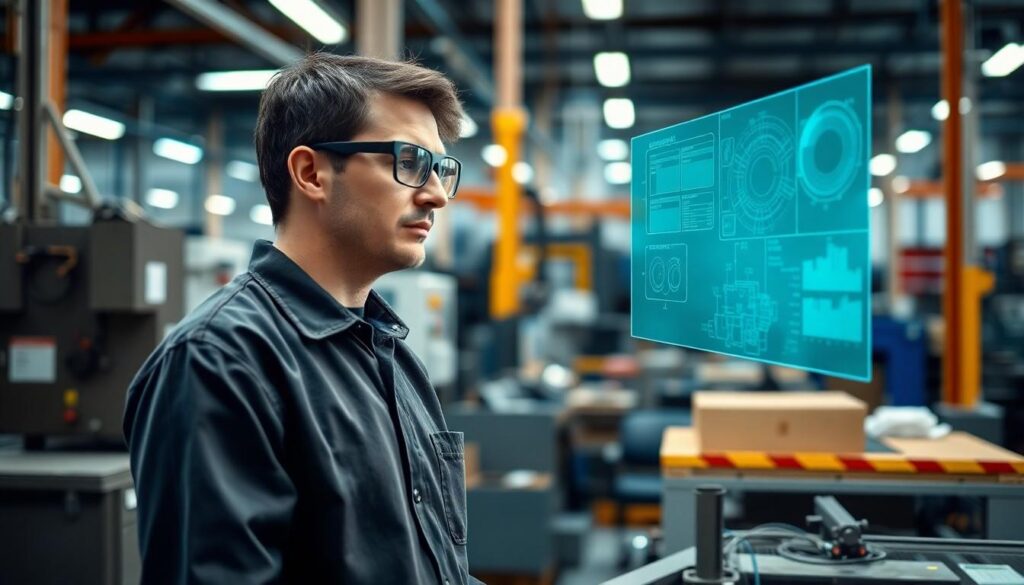
In a world where factories are often seen as a maze of machinery and monotony, augmented reality (AR) is shaking things up. Imagine workers donning smart glasses that overlay digital information right onto their workstations, turning complex tasks into a walk in the park. It’s like giving them a superpower—minus the spandex and cape.
Overview of Augmented Reality
Augmented reality (AR) represents a significant advancement in the manufacturing industry. This technology overlays digital information onto the physical world, enhancing real-time decision-making and efficiency. Workers benefit from immediate access to data, which aids in troubleshooting machinery or following assembly instructions.
Smart glasses serve as a key tool in AR applications, providing users with hands-free access to critical information and visual aids. By using these devices, employees experience fewer errors and reduced training time, translating to higher productivity levels. Visual cues and step-by-step guidance simplify complex processes, fostering a more intuitive workflow.
Companies integrating AR report improved maintenance outcomes as technicians utilize digital schematics displayed on their smart glasses. Enhanced collaboration occurs when remote experts provide real-time assistance, enabling on-site workers to resolve issues more effectively.
Investing in AR technology offers a measurable return on investment (ROI). According to a study, companies employing AR solutions experienced a 30% increase in operational efficiency. Enhanced safety training and risk reduction also result from AR’s immersive learning experiences, making environments safer for workers.
Organizations leveraging AR will find themselves at the forefront of innovation, responding adeptly to challenges in the manufacturing landscape. The ability to visualize data and interact with systems in real-time positions businesses for sustained growth and competitiveness. Real-time analytics, integrated with AR, empower decision-making at all levels of the organization.
Applications of Augmented Reality in Manufacturing Industry
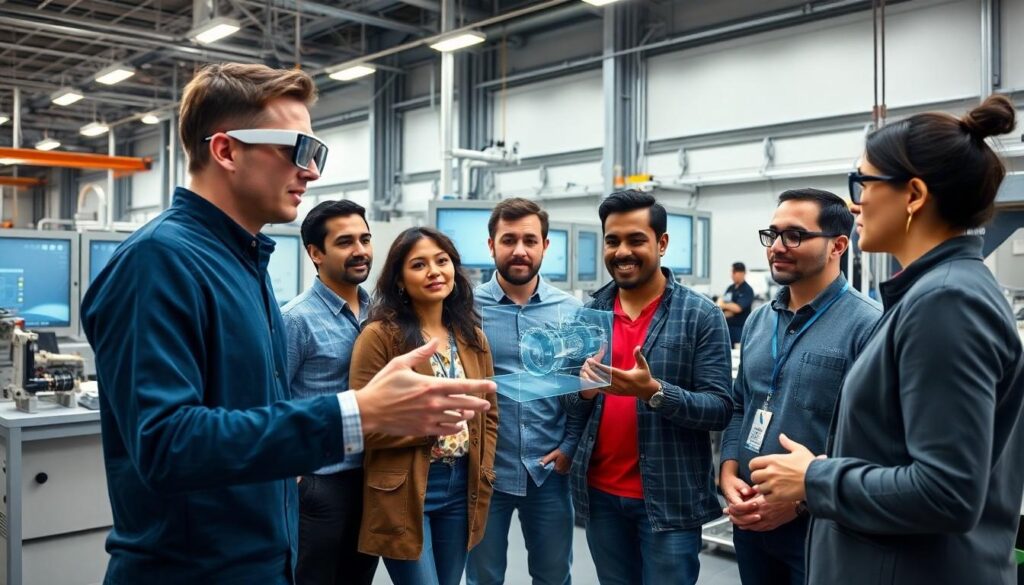
Augmented reality (AR) technology plays a crucial role in various aspects of the manufacturing industry, enhancing efficiency and effectiveness across multiple applications.
Design and Prototyping
Design and prototyping benefit significantly from AR tools. Designers visualize products in real-time, making adjustments easily before production. With digital overlays, stakeholders review prototypes without physical models, reducing material costs. Collaboration improves, as teams can interact with virtual representations during meetings. This approach accelerates the design process, shortening time to market. Moreover, AR allows for testing design functionality in real-world environments, ensuring usability and feasibility. Overall, AR streamlines the design workflow, yielding more innovative solutions that align with market demands.
Training and Education
Training and education processes increasingly incorporate AR solutions. New employees experience hands-on training through immersive simulations, enhancing knowledge retention. Instructions appear directly in their field of view, reducing the need for extensive training manuals. Experienced workers can mentor novices by sharing insights through AR interfaces, fostering a collaborative learning atmosphere. Safety training becomes more effective with interactive scenarios, highlighting potential hazards in real settings. Increased engagement leads to faster onboarding, ensuring teams operate at optimal efficiency. These advancements in training methods create a more skilled workforce, ready to tackle emerging challenges.
Maintenance and Repair
Maintenance and repair operations see marked improvements with AR applications. Technicians utilize smart glasses to access real-time data and digital schematics while working on machinery. This immediate access eliminates guesswork, allowing for precise repairs that minimize downtime. Remote experts can guide on-site technicians through complex procedures, fostering effective problem-solving. Tasks become easier to execute, significantly enhancing response times. Regular maintenance schedules also benefit from AR reminders, keeping equipment functioning optimally. Overall, AR technology reduces errors and increases productivity, leading to cost-effective maintenance solutions.
Benefits of Implementing Augmented Reality
Augmented reality (AR) revolutionizes the manufacturing landscape by providing tangible advantages. Enhanced productivity, improved accuracy, and reduced downtime emerge as significant benefits.
Enhanced Productivity
AR streamlines workflows and simplifies complex tasks. Workers access real-time data directly through smart glasses, which minimizes distractions. Employees complete their tasks more efficiently with instant access to instructions and schematics. Companies experience substantial productivity boosts, with reports indicating a 30% increase in operational efficiency. Workers perform at their best when equipped with AR tools that deliver immediate insights. As a result, tasks that once required extensive training now require less time, enabling personnel to focus on quality output.
Improved Accuracy
AR sharpens precision in manufacturing processes. Digital overlays guide workers, reducing the likelihood of errors during assembly and maintenance. With AR visuals, technicians receive clear instructions and enhanced schematics. Such clarity not only strengthens knowledge retention but also leads to more dependable results. Research highlights that AR-driven methods can substantially decrease error rates, which directly impacts quality control. Employees become more competent primarily due to AR’s support in decision-making, thereby bolstering overall product accuracy.
Reduced Downtime
Downtime significantly affects productivity in manufacturing settings, and AR helps mitigate this issue. Technicians equipped with smart glasses receive immediate, remote assistance from experts. This access allows for quicker troubleshooting, minimizing time spent on repairs. Deployment of AR technologies can slash downtime by providing real-time access to critical information during maintenance tasks. Companies leveraging AR platforms report faster resolution times, effectively leading to a smoother operational flow. Employees spend less time on unproductive activities, paving the way for increased efficiency and enhanced output.
Challenges and Limitations
Augmented reality (AR) in the manufacturing industry faces challenges that can hinder its effective implementation. Integrating AR solutions with existing systems proves complex due to varying software platforms and hardware configurations. Many legacy systems lack compatibility with new AR technologies, creating obstacles in seamless operation. Companies often encounter difficulties in data transfer, causing inefficiencies during training and maintenance tasks.
Cost plays a significant role in adopting AR technologies. Initial investment expenses for AR hardware and software can be substantial. Companies must evaluate costs against potential returns to justify expenditures. Additionally, ongoing maintenance and updates require budget allocation that some manufacturing companies may find challenging. Evaluating long-term benefits versus short-term costs becomes essential to assessing overall feasibility and ensuring a positive return on investment.
Future Trends in Augmented Reality for Manufacturing
Emerging trends in augmented reality (AR) promise to reshape the manufacturing landscape. Enhanced data analytics capabilities are increasingly integrated into AR systems, allowing predictive maintenance and better resource allocation. Workers will access advanced holographic displays, offering immersive experiences that transform the way they interact with machinery and tools.
Furthermore, 5G technology will facilitate faster data transmission, improving real-time collaboration between on-site staff and remote experts. Companies adopting AR alongside artificial intelligence will experience more personalized training programs, adapting content based on individual learning curves.
Self-guided AR applications may become more prevalent, allowing employees to navigate tasks with minimal supervision. The integration of AR with the Internet of Things (IoT) will enable machines to communicate with AR devices, providing context-aware information directly on the workstation.
Industry leaders foresee a shift towards customizable AR experiences, tailoring applications to specific manufacturing needs. For instance, AR tools may evolve to support multiple languages, enhancing accessibility for global workforces.
Increased investment in AR technology is likely, driven by a competitive need for improved efficiency and accuracy. Surveys reveal that companies leveraging AR report significant operational gains, reinforcing its growing importance in manufacturing.
Organizations focusing on sustainability will utilize AR to optimize resource use, reducing waste and energy consumption. As AR technology matures, collaboration between manufacturers and software developers will intensify, pushing boundaries in industrial innovation. Emphasizing these future trends highlights AR’s potential to further enhance productivity and workplace safety in the manufacturing industry.
Augmented reality is reshaping the manufacturing landscape by enhancing productivity and efficiency. With smart glasses providing real-time data and guidance, workers are empowered to perform tasks with greater accuracy and speed. The integration of AR not only streamlines workflows but also fosters a safer work environment through immersive training experiences.
As companies embrace this technology, they position themselves for future growth and innovation. The potential for AR to revolutionize processes from design to maintenance is immense. By investing in AR, manufacturers can unlock new levels of operational excellence while addressing the challenges of cost and integration. The future of manufacturing is bright with AR at the forefront, driving advancements that will shape the industry for years to come.